I have two blog posts in the works, and I never expected this little reflection would end up going live before either of them.
Recently I've been watching Blue Period on Netflix, and it moved me more than I anticipated. The story follows a Japanese high schooler who goes from knowing nothing about art to working his way toward an offer from his dream art school through Japan's notoriously brutal entrance exams. I used to find it puzzling why so many anime stories center on high schoolers, but I think I'm starting to understand. It's a stretch of life when you can still rewrite your own fate through sheer effort. Yatora's life won't be fundamentally transformed just because he gets into art school, but at eighteen, that hot-blooded chapter of striving is the entirety of his youth, and it gets a perfect ending. I think anyone who's watched the show can't help but feel happy for him.
At the start, Yatora knows nothing about art. Everything begins with a chance encounter — a painting by his senpai, Mori. He's struck from somewhere deep inside, and from that moment, he sets artistic creation as his goal. What hits him isn't the detached appreciation of a bystander; it's a desire to express something, welling up from within. It makes me think back to when I first stepped into AI — the seniors, the upperclassmen, the professors I met. What moved me was their conviction in the impact of their work, and the desire for self-expression that ran through it. Without my realizing it, that planted in me my own urge to create, to express.
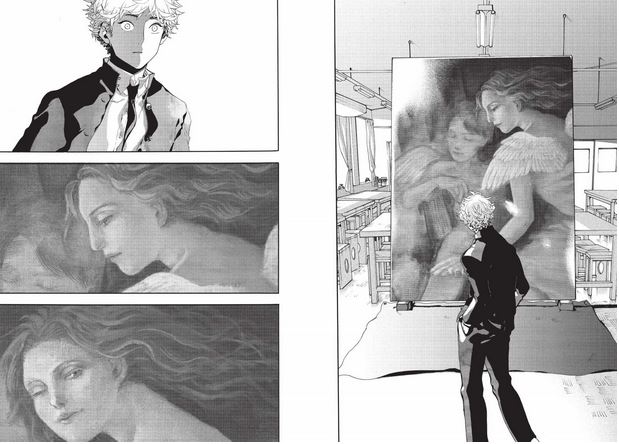
The show keeps returning to a pointedly anti-"talent" argument. When Yatora marvels at Mori-senpai's gift for painting, she pushes back — what he sees as beauty in her work is the product of her effort, not talent. To credit a piece to "talent" is, in a way, to dismiss everything its creator poured in beyond what ordinary people would. The word "talent" becomes a lazy shorthand that erases an ordinary person's labor. It overlooks her love for painting, for the act of expression itself — a love larger than the day-after-day, year-after-year drilling of fundamentals, the endless tweaking of color in an empty classroom, the studying of art history in corners no one ever sees. Watching that scene, something in me settled. My family often tells me, "It's okay if you fail this time. You're not a genius — don't push yourself so hard." And in pursuing my own desire to express, I keep worrying that I'm not good enough — that the questions I research and the projects I take on lack taste, that I'm short on talent. But somewhere deep down, there's a small flame that says: I can do this. If geniuses have their way, then I have mine. All of this is just me trying to satisfy the desire to express — to make something I'm satisfied with, as a thank-you to the people who once moved me.
A year after she graduates, Mori-senpai returns to their high school. She and Yatora miss each other again, and once again Yatora loses the chance to thank her, or to show her how far he's come. But just like the first time, when a painting brought them together, Mori-senpai sees his work. "What a wonderful piece" — the words slip out of her mouth. The season ends on that scene.
I think that, in the end, is what I want to do too.